

DESK YOGA FOR STAFF WELLBEING: EASY EXERCISES FOR EMPLOYEES TO DO AT THEIR DESK
Updated: May 21
Typical working lives have become increasingly sedentary. Whether you are based in the office, working remotely, or splitting your time between the two, many people now spend much of their day sitting at a desk, looking at a screen, and moving very little.
For HR teams, office managers, and wellbeing leads, this creates a growing challenge. Musculoskeletal issues, stress, fatigue, poor posture and reduced concentration are now some of the most common workplace wellbeing concerns across the UK.
The good news is that small, practical interventions can make a significant difference – and one of the simplest is desk yoga, also known as chair yoga.
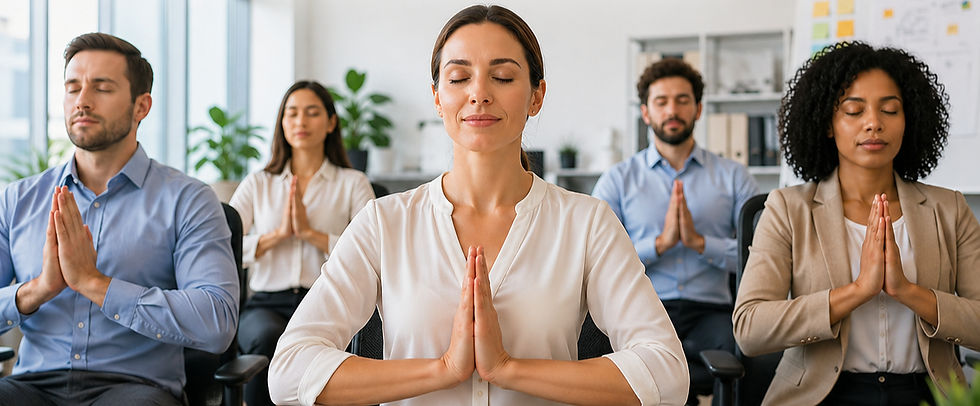
But don’t mistake this for an old person’s class! Desk yoga for staff wellbeing is an accessible, inclusive way to encourage movement, improve posture, reduce stress and help employees feel better both physically and mentally throughout the working day.
The hidden cost of sitting all day
According to the UK Health and Safety Executive (HSE), 511,000 workers suffered from work-related musculoskeletal disorders in 2024/25, resulting in 7.1 million working days lost. Stress related conditions and musculoskeletal problems remain the two biggest causes of work-related ill health in the UK.
The rise in home working has brought many benefits, but it has also introduced new challenges. Not everyone has an ergonomic workstation at home, and many people now spend even longer periods sitting without the natural movement that comes from commuting, walking between meetings, or interacting with colleagues in person.
Poor posture and prolonged sitting can contribute to:
Back and neck pain
Shoulder tension
Headaches and eye strain
Reduced circulation
Fatigue and low energy
Increased stress and anxiety
Reduced focus and productivity
Taking breaks improves productivity
Some people still equate being glued to the desk with productivity. In reality, the opposite is true. Research into attention and performance consistently shows that the brain works best in focused periods followed by short recovery breaks. 90 minute work cycles are considered optimal for concentration and performance.
When employees then pause briefly to move, stretch, breathe, or reset mentally, they typically return feeling:
More focused
More energised
Less stressed
More creative
Better able to concentrate
Short breaks are not lost time, they are an investment in sustained performance.
Simple things employees can do during a break
Not every break needs to involve exercise! The important thing is changing your physical or mental state for a few minutes.
Here are some simple ideas employees can use throughout the day:
Walk around – a short walk around the office, home, garden or around the block, can improve circulation, reduce stiffness and refresh concentration
Change mental focus – listening to music, reading something unrelated to work or stepping away from emails and messages for a few minutes can help reduce mental fatigue
Make a drink or have a chat – social interactions and brief moments away from a screen can improve mood and reduce stress levels
Do desk yoga or chair yoga – gentle movement and stretching can release tension, improve posture and boost energy without requiring special clothing or equipment.
Common objections to yoga at work – and why they are not real barriers
Despite the benefits, some employees still feel hesitant about trying office yoga or chair yoga during the workday, quoting concerns such as:
“I don’t want to get sweaty”
Desk yoga is designed to be gentle and accessible. The movements are slow stretches and mobility exercises rather than intense workouts.
“I don’t want to change clothes”
Chair yoga can be done comfortably in normal work clothes, sitting at a desk.
“I’m not fit or flexible”
That is exactly why these exercises are valuable. Desk yoga is suitable for beginners and can be adapted for all mobility levels.
“I don’t have time”
Even five minutes of movement can make a noticeable difference to posture, focus and energy.
“I feel self-conscious”
Many classes are held online, with participants given the OK to turn their cameras off. A good teacher has the skills to arrange the class to put people at their ease.
“I don’t know what exercises to do”
Simple guided sessions remove uncertainty and help employees feel confident getting started – clear, detailed instructions are given, with alternatives offered to support any mobility issues.
The benefits of desk yoga and chair yoga
Improved posture
Poor posture places strain on muscles and joints, especially around the neck, shoulders and lower back
Desk yoga helps employees become more aware of alignment while strengthening postural muscles and releasing tension caused by prolonged sitting
Better posture can also improve breathing and circulation.
Increased energy levels
Long periods of physical inactivity often result in people feeling sluggish
Gentle stretching and movement stimulate oxygen flow, helping employees feel more alert and energised throughout the day.
Reduced risk of injury
Regular mobility exercises can help improve flexibility, reduce stiffness and build resilience against common aches and pains
Doctors and physiotherapists frequently recommend chair-based movement and stretching exercises for people experiencing neck and back discomfort linked to desk work.
Better mental wellbeing
Chair yoga goes beyond stretching alone. Unlike other types of exercise, yoga at work also incorporates breathwork and mindfulness techniques that support:
Stress reduction
Better sleep quality
Improved mood
Greater mental clarity
Just a few minutes of mindful breathing alongside gentle movement can help calm the nervous system during a busy or stressful day.
Easy desk yoga exercises you can try
You can follow a five minute class at https://www.youtube.com/watch?v=vXuExkegPnc
Or work your way through the simple exercises below. Everything can be done in a chair, with no equipment required.
Exercise 1: Shoulder raises

Inhale and raise your left shoulder up to your ear, exhale and raise your right shoulder as you relax your left shoulder down. Continue for a minute and then change the breath, inhaling your right shoulder up and exhaling your left shoulder up. Continue for another minute and then change to double shrugs, inhaling both shoulders up, exhaling and letting them drop. Not only does this exercise release tension from your shoulders and neck, but it also increases the flow of blood to your brain so gives you a burst of energy.
Exercise 2: Sweep arms up and down

Let your arms dangle down by your sides, inhale and sweep your arms up overhead and tilt your chin up as your palms come together. Hold the breath in for two seconds as you turn your wrists so the backs of your hands are touching, then sweep your arms back down to the starting point and bring your chin down to the chest.
Exercise 3: Push/pull hands

Raise your arms up parallel to the ground, palms forward so your fingers point up to the ceiling. Alternately push forward and pull back as if trying to push the air in front of you. Make the pull back as important as the push forward. Co-ordinate the movement with your breath so one hand is pushing forward on the inhale and the other hand is pulling back on the exhale. Do the exercise with your eyes closed for a deeper internal experience and to cut out visual noise and distractions. As you swing your shoulders you should be able to feel a churning to your rib cage, which massages your internal organs.
Exercise 4: Spinal twist

Bring your hands on to your shoulders, fingers point forward, thumbs back, elbows up to the side. Inhale and twist to the left, exhale and twist to the right. Take your head around as you go. Not stopping at any point, you are looking for a nice, fluid movement.
Exercise 5: Hip stretches

Hold onto your right knee with your hands clasped together, draw it into your chest, breathe long and deep. After 30 seconds, start drawing circles in the air with your knee, change directions after 30 seconds. Bring your right foot down and swap sides, drawing the left knee into your chest and repeating the sequence.
Why chair yoga is ideal for workplace wellbeing
One of the reasons chair yoga works so well in workplace settings is accessibility. Employees do not need:
Special equipment
Gym clothes
Yoga experience
Large spaces
High fitness levels
It is inclusive, practical and easy to integrate into the working day.
For organisations looking to improve staff wellbeing in a realistic and sustainable way, office yoga sessions can be a highly effective addition to an employee wellbeing programme.
They support both physical and mental wellbeing while also helping create a culture where taking care of health at work feels normal and encouraged.
Bringing desk yoga into your workplace
Creating a healthier workplace culture does not require dramatic changes. Sometimes the most effective wellbeing initiatives are the simplest:
Encouraging regular movement
Building short recovery breaks into the day
Giving employees practical tools to manage stress and discomfort
Making wellbeing visible and accessible
Desk yoga for staff wellbeing is a simple but powerful way to support healthier, happier and more productive teams.
By introducing simple practices like desk yoga, organisations can help employees feel better physically, mentally and emotionally while also supporting productivity, engagement and resilience.
Small movements, practised consistently, can have a surprisingly big impact.
Desk yoga for staff wellbeing FAQs
Q: What is desk or chair yoga?
A: It’s what it says on the tin: yoga exercises done sitting in a chair! The benefits of yoga are well documented, including less stress, more energy, reducing tension in the body and the mind. Yoga done in a chair brings additional benefits, such as: shorter sessions that don’t get in the way of the working day, no need to change out of work clothes and specific work done to ease the aches and pains caused by working for hours in a chair.
Q: How often should desk yoga be done?
A: Taking the time to do a 20 minute class every day is not realistic for most people. So we recommend getting into the habit of doing just a few minutes: if you take just three minutes as you settle in first thing, you will immediately benefit from a little boost of morning vitality. It’s not unusual to feel sluggish mid afternoon, so another three minutes will help lift your energy levels. Just 180 seconds can make a significant difference to your whole day.
Q: Is desk yoga effective at reducing back pain?
A: Yes it is, which is why it is recommended by doctors and physiotherapists. The lower back, neck and shoulders are the most affected areas. Carefully taught, gentle twisting and stretching exercises are able to build strength and flexibility, increasing blood flow and helping repair damaged tissue.


Comments